Dave Odom 1-3-1
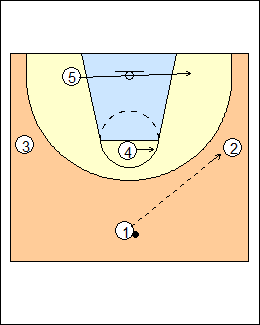 | 1 Dave Odom 1-3-1 set. A passive zone defence doesn't come outside the arc, react to every pass or chase too hard, it makes you shoot the 3. An attack zone chases every pass and pressures the ball. Teach zone-attack principles first (and don't rely on what you taught last year, you have to re-teach): - against a passive zone, take the ball to the defence, dribble penetrate a gap, draw two defenders, pass - against an attack zone, move the ball - use the high post to keep the defence in, make them guard it - dribble throw-back - fake a pass, make a pass, analogous to dribble throw-back (shift the zone) - make the extra pass. High-post 4 is a better passer than low-post 5, and doesn't let a zone defender stay in the passing lane. 5 gets ballside with his back on the baseline and hands up to see what's coming at him, get separation so one defender can't guard 4 and 5, and be clear anytime a bottom defender gets pulled up. Tom Izzo, Jack Bennett - never have 1 and 4 in a tandem (they are offset). Mads Olesen - Fresno 2-game - from a 4-out set, run trailer 4 through to the short corner, 5 will occupy mid post to high post, 1 gets ballside and available for a pass from 2, even if he has to go toward the sideline at midcourt. See Zone set plays - Florida ballscreen 3s, Fresno 20 series. Billy Donovan - Florida normally starts 3-out 2-in against zone with the bigs on the blocks, then tries to overload the baseline (low) or the top. Tom Izzo - they usually start in a 1-2-2 then flash a big high to get into a 1-3-1 quickly. Never have the point guard and the high post in a tandem. Jack Bennett - against a 3-2 zone you can start the offence by ballscreening the top. Steve Cleveland - the high post screens the odd-fronted zone to start the offence (smack action). |
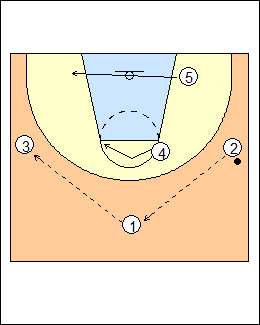 | 2 Ball reversal. Geno Auriemma - on ball reversal the rule is pass to the baseline if the bottom defender comes out on the ball, or pass the ball right back if a top defender comes out. (Option - 5 moves block to block but steps out to the short corner if a bottom defender comes out on the ball, see Bill Self, also Heath Millar) Dave Arseneault (Grinnell) - if 4 can't get the ball after one reversal from side to side, he will probably step out of the high post and the low post will replace him, or they have an open set and rely more on dribble penetration. coachesclipboard.ca - one way to get the ball into the middle of the zone is by posting at the elbow, with your back to the far sideline. On ball reversal, post there against a guard defender recovering from the ball (seal him outside). Perimeter players must get every third pass into the high post, see the middle of the zone, be patient, and use pass fakes to create passing lanes (e.g., a pass fake from the wing to the top will often influence the top defenders higher). Olesen - the post follows the ball around in a half-moon shape from mid-post to high-post, getting all the way to the high post is important to draw up the middle zone defender. If on the swing 1 freeze dribbles the top defender before passing to 3 it forces a bottom defender to cover 3, leaving open the post or short corner. Often the swing through the post will be open, on the pass from 2 to 1, 4 jumps to the high post, gets the ball and reverses it, if 3 is able to hit the short corner, it will often lead to a wide open layup for the diving 4 (see Geno Auriemma). |
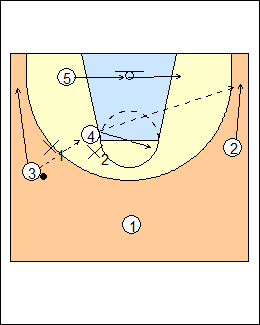 | 3 4 does not stay behind defender X2, he steps clear up or down. On a pass to 4 he in effect becomes the point guard, he turns and looks low, 5 gets his head under the rim for a second, 4 will fake high (shot or pass) and bounce pass low. The wings space and drop to the corners, 4 goes ballside if he passes to a wing, the principle is outside, inside, look low, reversal, follow the ball. (Drag action option - 2 dribbles back out to the wing, looking for 5 if a bottom defender is on the ball, see Bill Self, Heath Millar, Kermit Davis zone motion) Olesen - 5 goes backdoor to the other short corner while the pass to 4 is in the air, 3 relocates to the corner, 5 would come back ballside on a pass to 3, and 2 get on a diagonal weakside. |
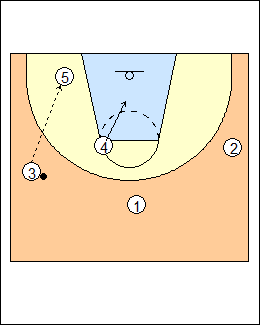 | 4 On a pass into the low post, the high post comes down looking for an air pass. (Crackdown option - if 5 fans the ball to 1 or 2, 4 screens for 5 then comes high, see Bill Self) |
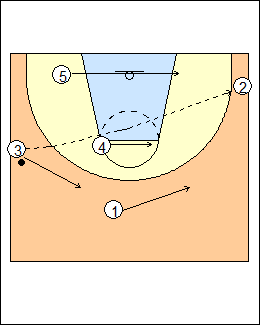 | 5 Skip passes are good (not great), a wing-corner skip pass is better than a corner-wing skip pass, there is less chance of interception and the point guard is back for defensive balance. (Skip-skip option - on a skip pass 5 pin screens the weakside of the zone for a return skip pass then seals, see Kermit Davis zone motion) Olesen - when both 4 and 5 are active and can move, run 4X, always have them X-cut on a skip pass, and possibly any ball reversal. Penetration from the top will often be open on ball reversal or skips, when the whole defence is moving in the other direction (here 2 would pass to 1 for a drive left). Jack Bennett - the best time to beat a zone with dribble penetration is off a skip pass. |
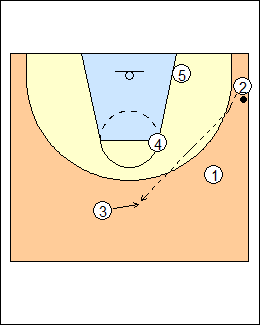 | 6 For a skip pass out of the corner (or low post), make sure that 3 comes ballside. |
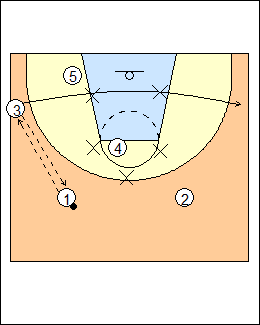 | 7 Normally go 2-1-2 against a 1-2-2 (even versus odd), but only if 4 or 5 is comfortable in the corner. Otherwise 3 runs the corners, the roles of 4 and 5 don't change. (Variations) - 3 and 4 exchange on ball reversal - 5 crosses the lane only on a pass to 3. See Dave Odom vs 1-3-1.  |
This page was made with Basketball playbook from Jes-Soft