Cincinnati
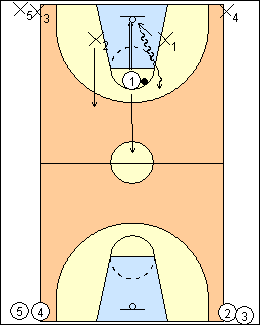 | 1 Two teams, 2-on-1, 3-on-2, 4-on-3, 5-on-4, then 5-on-5. 1 starts play with a free throw against X1 and X2, who rebound then attack 2-on-1 the other way against 1 (who can rebound the free throw and score). |
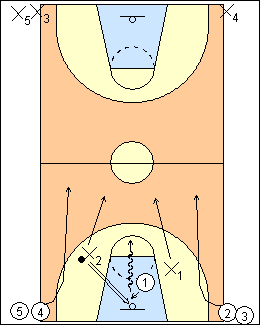 | 2 On a stop or score, 1 attacks with 2 and 4 in a 3-on-2 against X1 and X2. When that attack is over, X3 and X4 come on to join X1 and X2 in a 4-on-3 attack against 1, 2 and 4. The next attack will be 5-on-4 by team O as 3 and 5 come on. Then X5 comes on for a 5-on-5 attack by team X. Team X starts play with a free throw in the next round. Variations - go 5-on-5 until a score, or first team to score twice - coach at each end, who must be passed the ball by the new attackers on each change of possession - inbound after a make - only one attacker joins on each stop or score, creating 2-on-2, 3-on-2, 3-on-3, etc. - start with a 1-on-1. See Transition - Winnipeg. Brian McCormick - 2-on-1 (fullcourt), 3-on-2, 4-on-3, 5-on-4, then 5-on-5 until a score, flip-flop teams. Herb Brown - fullcourt 2 on 1, 3 on 2, 4 on 3, 5 on 4, 5 on 5, play each possession to a stop or score. Mads Olesen - 2-on-1, one shot only, outlet, then 3-on-2, 4-on-3, 5-on-4, 5-on-5 to a stop or score. Fabian McKenzie - Cincy - start with a free throw then 2-on-1, 3-on-2, 4-on-3, start over with new groups. Mike Jones - start with a free throw, at 5 on 5 play until one team scores. Greg Kampe - pro drill - free throw to 2 on 1, 3 on 2, 4 on 3, 5 on 4 (5 on 5). It's pick-up, players love it. Can put in rules, e.g., no shot until the ball goes inside the pack line, or into the post, or is driven into the key. Don Showalter - this is how the U.S. national teams starts 5 on 5 scrimmage. |
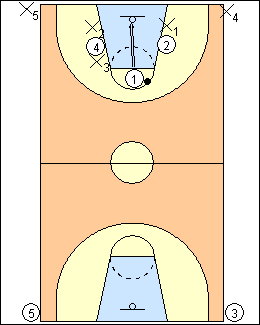 | 3 Bob Huggins Start practice with 2-on-1, 3-on-2, 4-on-3 (inbounds a make), can work up to 5-on-5 and run a secondary break. Stop and run the defenders if they give up a layup. Losers run the point difference in suicides. Also do 4-on-3, 5-on-4, 5-on-5 starting with a foul shot. (Variation - for international rules, start with a 3-on-3 foul shot, then go 4-on-3, 5-on-4, 5-on-5, shown)  |
This page was made with Basketball playbook from Jes-Soft